Taught by Watching: The Shadow Lineage Enson Inoue Never Knew He Created
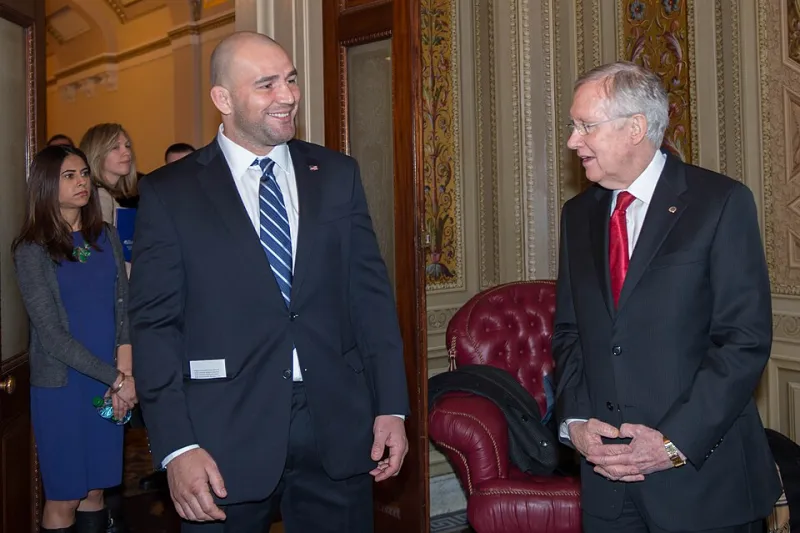
Photo: United States Senate Democrats, Public domain, via Wikimedia Commons
There's a certain kind of teacher who never writes a syllabus. They don't hold office hours or hand out belt promotions. They just do the work — visibly, honestly, at full intensity — and somewhere in the back of the room, someone is taking notes.
Enson Inoue was that kind of teacher. And the room was a lot bigger than anyone realized.
The Gym That Never Had a Sign on the Door
If you asked most fighters in the late 1990s and early 2000s where they were getting their grappling education, they'd name a coach, a camp, a lineage. But dig a little deeper and a pattern starts to emerge. A lot of guys — especially American fighters grinding through regional circuits or piecing together self-taught ground games — were watching tape. Specifically, they were watching Inoue.
His fights were circulated on VHS dubs and, later, early internet downloads, the kind of low-res files you'd wait forty minutes to load on a dial-up connection. None of that stopped people from watching. Over and over. Pausing at the exact moment his hips shifted, rewinding to catch how he'd set up an arm bar from what looked like a completely neutral position.
That's not a formal education. But it's absolutely a real one.
What Made Him Worth Studying
Here's the thing about Enson's ground game that made it so instructive: it was legible. That might sound like a strange compliment, but it matters. A lot of elite grapplers move in ways that are nearly impossible to decode in real time. The mechanics are buried under speed, pressure, and instinct that took decades to develop. You can watch, but you can't quite follow.
Inoue was different. His transitions had a logic that you could trace. When he moved from a dominant position into a submission attempt, there was a clarity to the sequence — a cause-and-effect chain that a careful observer could actually map. That made him uniquely teachable even from a distance.
His work on the ground wasn't flashy. It wasn't built for highlight reels. It was built to finish fights, and that utilitarian honesty made it easy to study and hard to argue with.
The Fighters Who Learned Without a Handshake
We're not going to pretend we have a comprehensive list here, because that's not really how this kind of influence works. It doesn't get documented. Nobody fills out a form that says "I rebuilt my triangle choke game based on Enson Inoue footage from 1998." It just quietly becomes part of how a fighter moves.
But talk to enough grapplers who came up during that era — particularly in the American Midwest and Pacific Northwest, where access to elite BJJ instruction was spotty at best — and the name comes up. Sometimes as a direct reference. More often as part of a broader description of "the guys I was watching" before anyone had a Netflix queue or a YouTube algorithm doing the curation for them.
That informal transmission is actually how a lot of martial arts knowledge travels. Not through lineage charts and certified instructors, but through observation and imitation and the slow accumulation of borrowed instincts.
Why "Influence by Osmosis" Is Still Influence
There's a tendency in MMA circles to discount this kind of indirect impact. If you can't point to a direct student, if there's no gym affiliation to trace, the argument goes that the influence isn't really there. That's a pretty narrow definition of teaching.
Consider how American basketball players absorbed moves from watching international players on tape before the NBA became a fully global league. Consider how guitar players in the American South rebuilt their technique from scratchy recordings of players they'd never meet. The mechanism is the same: you see something that works, you internalize it, you adapt it to your own body and your own game, and eventually it becomes yours.
Enson Inoue's submission approach — the economy of movement, the patience before the strike, the willingness to stay composed in uncomfortable positions — those principles didn't disappear when his fight career wound down. They migrated. Into training rooms and sparring sessions and regional fight cards across the country, carried by fighters who maybe couldn't have told you exactly where they picked it up.
The Irony of the Uncredited Curriculum
Here's what makes this story a little bittersweet. The fighters who were most directly influenced by formal MMA coaching programs often have a clear, traceable lineage they can point to. Their influences are documented. Their teachers get credit.
The fighters who pieced their games together from tape study and instinct? Their influences are scattered and uncredited. And that means Inoue — who arguably did more to demonstrate what a complete, principled submission game looked like during a formative period for American MMA — gets less formal recognition than coaches who produced far fewer actual breakthroughs.
That's not a complaint on his behalf. Enson Inoue never seemed like someone who spent a lot of time worrying about credit. But it's worth naming, because legacy gets distorted when we only count the influences we can document.
What the Shadow Lineage Actually Looks Like
Picture it this way. Somewhere in Ohio in 2001, there's a guy training out of a wrestling room who's trying to figure out how to make his ground game more dangerous. He's got decent takedowns but no real submission threat. He gets his hands on a tape of Inoue working through an opponent on the ground and watches it until the tracking goes fuzzy.
He doesn't know who Enson Inoue is beyond a name on a label. He doesn't know about the Shooto circuit or the fights in Japan or the cultural weight of the career. He just knows that the guy on the tape moves like he has a plan, and he wants to move like that too.
That guy goes on to coach twenty fighters over the next decade. And some of those fighters go on to compete, to teach, to influence. The chain extends outward from a VHS tape in a wrestling room, and somewhere at the origin point, there's Enson Inoue — teaching a class he never knew he was running.
The Lesson That Didn't Require a Mat
The real takeaway here isn't just about submission technique. It's about what it means to do your work with enough integrity and clarity that it becomes useful to people you'll never meet.
Enson Inoue fought the way he trained and trained the way he believed. That consistency — that refusal to perform for the cameras or simplify for the highlight reel — is exactly what made him worth studying. The fighters who absorbed his influence didn't get a watered-down version designed for mass consumption. They got the real thing, unfiltered.
That's a harder legacy to measure than a gym full of direct students. But it might be a more durable one.