The Art of Getting Out: Why Enson Inoue's Defensive Grappling Framework Is the Missing Piece in Most MMA Programs
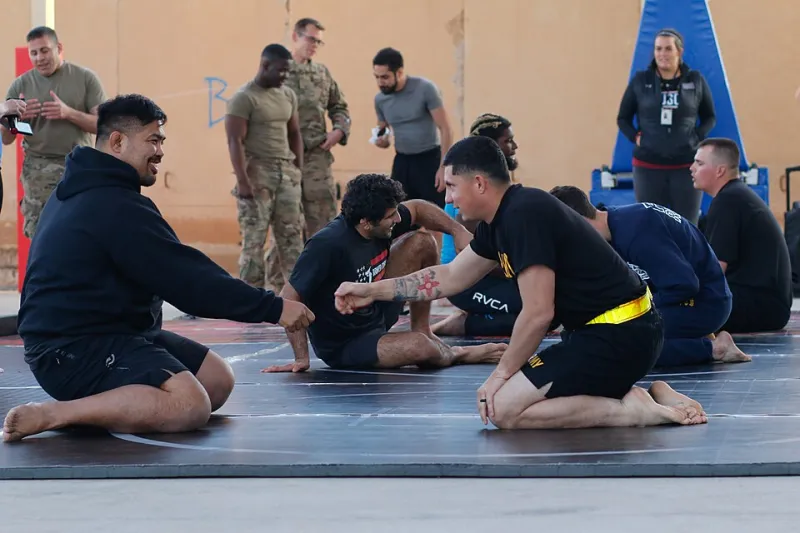
Photo: AL ASAD AIR BASE, IRAQ 12.18.2018 Photo by 1st Lt. Leland White 201st Regional Support Group, Public domain, via Wikimedia Commons
Walk into almost any MMA gym in the country on a Tuesday night and you'll see the same thing. Coaches drilling offense. Setups for the triangle. Entries into the rear naked choke. The D'Arce, the guillotine, the arm-in ezekiel. Submission offense is sexy, it's fun to teach, and it looks great on highlight reels.
What you almost never see is a coach standing in the middle of the mat saying, "Okay, today we're going to spend the whole session learning how to not tap."
That gap — that enormous, career-ending gap — is exactly where Enson Inoue made a home.
The Offensive Obsession Problem
American MMA has a complicated relationship with defense. Striking coaches preach head movement. Wrestling coaches drill scrambles. But grappling defense — specifically, the technical work of surviving deep submission attempts and finding your way back to neutral — gets treated like an afterthought in most programs.
The logic, if you can call it that, usually sounds something like: "If you're in a bad position, you shouldn't have gotten there in the first place." That's the kind of advice that sounds smart until you're six minutes into a hard round with someone who's better than you on the ground, and you're desperately trying to remember what your coach said about posturing up from mount.
Enson Inoue operated from a completely different philosophy. His approach wasn't just about attacking submissions — it was about building a complete grappling ecosystem where defense and offense fed each other. You couldn't fully understand one without the other.
Staying Technical When Your Brain Wants to Panic
Here's the thing about being locked in a submission attempt: your body does not want to be calm. Your heart rate spikes. Your instincts push you toward explosive, uncoordinated movement. Most fighters — especially early in their careers — respond to a tight armbar or a locked-in triangle by burning every ounce of energy they have in a single, desperate scramble. Sometimes it works. Usually, it makes things worse.
What Inoue demonstrated across his career was something more disciplined. When caught in compromised positions, he moved with intention rather than desperation. There's a reason for that. Panic-based escapes create openings. A fighter who thrashes randomly against a locked triangle often gives up the back or transitions directly into a worse submission. Inoue understood that controlled, sequential movement — even when the clock is ticking on a locked joint — is more likely to produce a real escape than raw athleticism.
That principle alone is worth an entire semester of mat time. Teaching fighters to slow their breathing, assess the lock, and move in coordinated sequences rather than explosive bursts is genuinely difficult. It requires mental training as much as physical. But it's the kind of thing that separates fighters who survive bad positions from fighters who tap every time someone gets their grips set.
Posture as a Weapon
One of the most underrated concepts in Inoue's defensive framework is the role of posture — not in the striking sense, but in the grappling sense. Maintaining structural integrity under pressure is a skill that most fighters only develop after years of getting submitted, if they develop it at all.
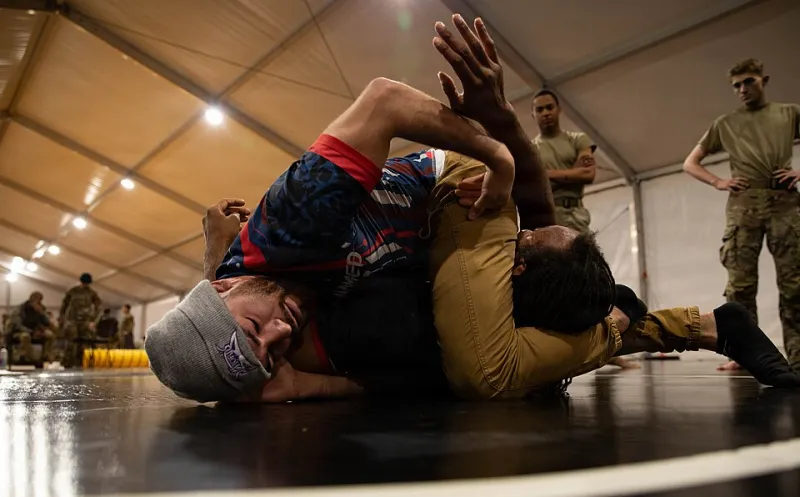
Inoue had an exceptional ability to stay structurally sound in positions where other fighters collapsed. When caught in guard with a submission threat active, the tendency for most fighters is to fold toward the danger, giving up posture in an attempt to relieve pressure. That almost always makes things worse. Good posture — hips back, base solid, spine neutral — creates the space necessary for actual escapes rather than just delaying the inevitable.
You can see this principle play out in modern grappling competition too. The best defensive grapplers in the world aren't just strong — they're structurally disciplined. They know how to use their frame to buy time and create angles. That's not something most American MMA gyms drill in any systematic way, but it's central to what made Inoue so difficult to finish.
The Reversal Mindset: Defense as Transition
Perhaps the most sophisticated element of Inoue's defensive philosophy was the way he treated escape attempts not as endpoints but as transitions. The goal was never simply to survive a submission — it was to use the mechanics of the escape to arrive somewhere useful.
That's a meaningful distinction. A fighter who escapes a triangle and ends up back in standing guard has survived, technically. But a fighter who escapes a triangle and ends up taking the back has turned a defensive moment into an offensive one. Inoue understood that the energy required to defend a submission creates momentum, and that momentum can be redirected.
This concept — defense as the setup for offense — is genuinely advanced. It requires a fighter to think at least two steps ahead while under serious physical stress. Most fighters can barely think one step ahead when they're getting choked. But training this way, drilling escapes not as standalone techniques but as entries into follow-up positions, changes how a fighter processes pressure entirely.
Why Amateur Fighters Need This More Than Anyone
Here's the argument for why Inoue's defensive framework is actually more applicable to developing fighters than his legendary offensive work.
Amateur and early-professional fighters lose fights on the ground because they get submitted in bad positions. Not because they don't know enough submissions. They know plenty of submissions. What they don't have is a systematic way to survive the moment when someone better than them locks something up and starts applying pressure.
Teaching an amateur fighter to throw a triangle is relatively straightforward. Teaching that same fighter to stay calm when someone else's triangle is halfway locked in — to move correctly, to use posture, to find the escape that leads somewhere productive — is a completely different challenge. And it's the one that actually wins and loses fights at the developmental level.
Inoue's career is full of moments where his defensive intelligence allowed him to outlast situations that would have ended most fights. Studying those moments and breaking down the underlying principles isn't just an academic exercise. It's a practical curriculum that coaches could be using right now.
The Case for Putting Defense First
The culture around submission grappling in MMA has always leaned toward offense. That's understandable — offense is what gets the finish, and the finish is what gets the highlight. But the fighters who last, the ones who build real careers and accumulate real experience, are almost always the ones who figured out how to survive.
Enson Inoue figured it out. He built a defensive framework that was technically sophisticated, mentally demanding, and practically effective. And somewhere along the way, American MMA mostly looked past it in favor of the next cool submission sequence.
That's a mistake worth correcting. Because if you can't get out, the offensive stuff doesn't matter much anyway.