Camp or Chaos: How Enson Inoue Turned Fight Preparation Into a Science While Everyone Else Was Winging It
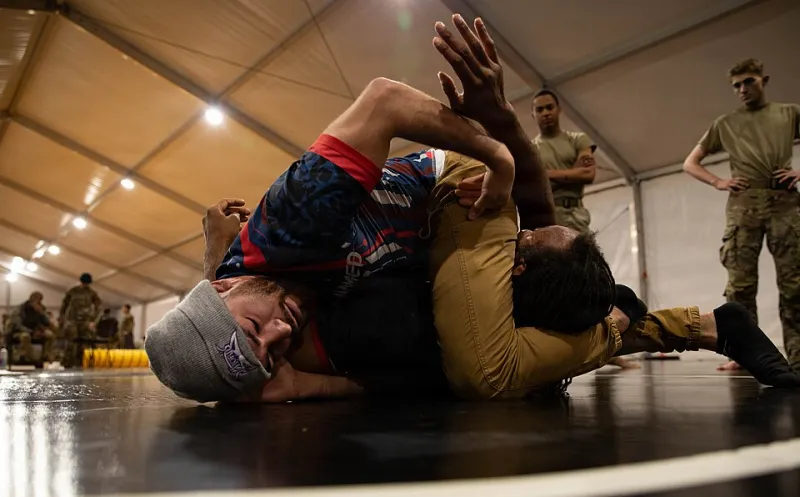
Photo: U.S. Army Reserve photo by Staff Sgt. Emilie Lenglain, Public domain, via Wikimedia Commons
There's a version of fight camp that most American fighters knew intimately in the late '90s and early 2000s. It looked something like this: get the fight booked, hit the gym hard for six weeks, spar until you're half-broken, cut weight like your life depends on it, then show up and hope the adrenaline carries you through. It wasn't a system. It was controlled desperation dressed up as preparation.
Enson Inoue didn't do that.
What Enson built — across years of competing in Japan's Shooto circuit and eventually on the global MMA stage — was a preparation philosophy rooted in deliberate thinking rather than frantic activity. He wasn't just training harder. He was training smarter, which in that era was genuinely rare, especially for someone operating outside the well-funded American gym ecosystem.
Understanding the gap between what Enson did and what most of his contemporaries were doing tells you a lot about why certain fighters age well as legacies and others quietly fade from the conversation.
Start With the Decision, Not the Drill
One of the most overlooked parts of Enson's approach was how seriously he took the opponent selection process itself. For a lot of fighters, taking a fight was a financial or ego-driven call. The money made sense, the name looked good, or the promoter pushed hard enough. Preparation came after the decision.
Enson flipped that sequence. Before committing to a matchup, he was already thinking through what the fight would demand. What kind of game plan would be necessary? Did his current skill set align with what this specific opponent would bring? Was there enough time to build what he'd need?
That kind of pre-commitment analysis sounds obvious when you say it out loud. But in an era where fighters were often taking bouts on two weeks' notice and treating every camp the same regardless of the opponent, it was genuinely countercultural. Enson was asking strategic questions before he ever laced up a glove in preparation for a specific fight.
This mattered because it meant his camps had a target. They weren't generic fitness blocks. They were built around a specific problem he needed to solve.
The Architecture of a Purposeful Camp
Once Enson committed to a fight, his camp structure reflected something you'd recognize in today's elite-level training environments but would've looked foreign to most American gyms of that period: everything had a reason.
Technical work wasn't just drilling moves. It was drilling answers — responses to the specific threats a given opponent posed. Sparring wasn't open chaos. It was scenario-based, designed to stress-test the game plan under pressure. Conditioning wasn't just about being in shape; it was calibrated to the pace and duration the fight was likely to demand.
This kind of intentionality traces back directly to his time in Japan's Shooto organization, where the culture around martial arts preparation was more methodical and philosophically grounded than what was happening in American gyms. Shooto fighters weren't just athletes. They were students of combat in a real sense, and that ethos shaped the way Enson thought about getting ready to compete.
The result was a fighter who walked into cages and rings with a clarity that his opponents often lacked. He wasn't discovering his game plan in round one. He already knew what he wanted to do and had spent weeks building the physical and mental pathways to execute it.
When Preparation Shines — and When It Can't Save You
Look at Enson's best performances and you can see the fingerprints of this philosophy. The submission victories that looked almost inevitable — the kind where he seemed to be three steps ahead — weren't accidents. They were the product of camps where he'd already mapped the territory. He knew where the openings would appear because he'd spent weeks creating the conditions that produced them.
But here's where the honest analysis matters: even a great preparation system has limits.
Enson's clash with Fedor Emelianenko is a useful reference point. There are matchups where the preparation gap isn't about process — it's about the sheer physical and technical reality of who's across from you. Fedor in that period was operating at a level that most preparation systems couldn't fully account for. What Enson's camp philosophy gave him in that fight wasn't a path to an easy win. It gave him the ability to compete with his chin up, to execute something coherent even under extreme pressure, and to leave the cage having represented himself the way a warrior should.
That distinction matters. Preparation doesn't guarantee outcomes. What it guarantees is that you show up as the best version of what you've built. Desperation, on the other hand, guarantees you show up reactive and scattered — and that never helps.
The Mental Layer That Most Camps Skip
What separated Enson's approach even further was the psychological dimension he wove into preparation. American fight camps of that era were almost exclusively physical. You trained your body, you maybe watched some tape, and you dealt with the mental stuff on fight night when you had no choice.
Enson treated mental readiness as a training variable, not an afterthought. This wasn't about visualization gimmicks or motivational speeches. It was about building genuine composure through the process of preparation itself. When you've done the work methodically, when you've stress-tested your game plan, when you've thought through the scenarios — you arrive at fight night with a kind of settled confidence that reactive camps can't manufacture.
Modern sports psychology has a lot to say about this. Elite fighters today talk about "process focus" and "emotional regulation under pressure" as core competencies. Enson was living those principles before the vocabulary existed to describe them cleanly.
What Today's Fighters Can Actually Take From This
If you're a fighter or a coach reading this and thinking about how to build better camps, the Enson Inoue framework boils down to a few practical shifts.
First, make the decision to fight part of the preparation process, not separate from it. Before you say yes, understand what yes is going to require.
Second, build camps around specific problems, not generic fitness. Every drill, every sparring session, every conditioning block should have a clear answer to the question: why does this make me more ready for this specific fight?
Third, include the mental dimension deliberately. Composure isn't something you find on fight night. It's something you build in the weeks before through the quality and intentionality of your preparation.
And finally, be honest about the difference between preparation and activity. Busy camps feel productive. Purposeful camps are productive. The distinction is easy to miss when you're exhausted and the fight is close, but it's the whole game.
Enson Inoue didn't have the biggest platform or the most resources. What he had was a refusal to confuse motion with direction. In a sport that still struggles with that distinction, that's a legacy worth studying.