Chain Reaction: How Enson Inoue's Submission Transitions Left Opponents With Nowhere Left to Go
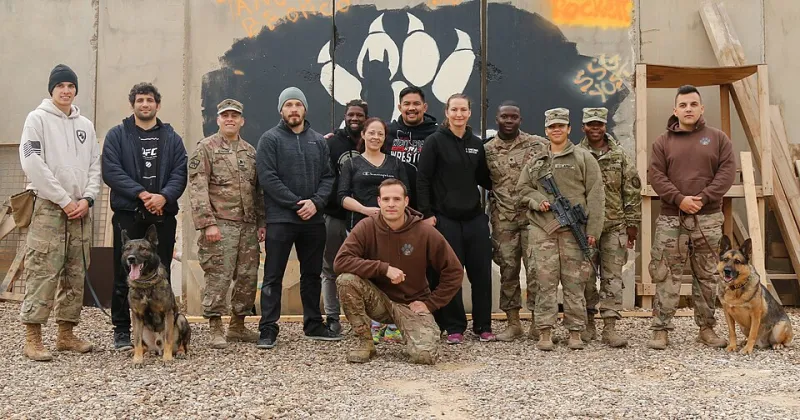
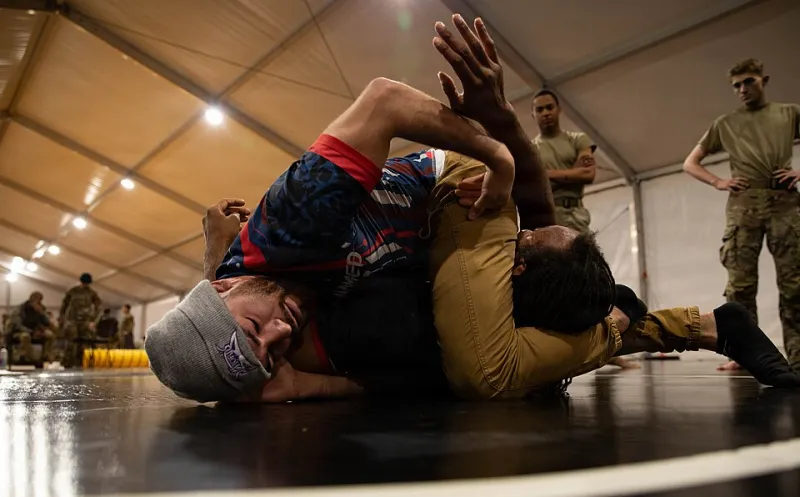
Photo: AL ASAD AIR BASE, IRAQ 12.18.2018 Photo by 1st Lt. Leland White 201st Regional Support Group, Public domain, via Wikimedia Commons
When One Move Becomes Many
Here's something most casual fans never quite understood about Enson Inoue on the mat: he wasn't hunting for a single submission. He was running a sequence. Every arm he grabbed, every angle he shifted toward, every moment of pressure he applied was part of a chain—one that was already two or three steps ahead of wherever his opponent thought the fight was going.
That's a different way of thinking about grappling than what most American fighters were raised on. In the late 1990s and early 2000s, the dominant ground game philosophy in U.S. gyms was positional. Get to mount. Get to side control. Look for the finish from there. Clean, simple, logical. Enson didn't ignore position, but he treated it as fluid rather than fixed. Where others saw a locked-down spot on the mat, he saw a pivot point.
The result was a submission game that looked almost improvisational but was anything but.
The Mechanics of Chaining
To understand what made Enson's transition game unusual, you have to understand what makes submission chaining hard in the first place.
When you attempt a submission and your opponent defends, you're in a bad spot. You've committed to a position, your opponent now knows what you're going for, and you've often given up leverage in the process of attacking. Most fighters at that point reset—scramble back to a neutral position, reestablish control, and try again. That reset costs time, energy, and momentum.
Enson's approach cut that cost almost entirely. His transitions were designed so that the defense itself opened the next attack. If you moved your arm to escape an armbar, you were feeding a triangle. If you posture up to relieve pressure from a triangle, you were walking into an omoplata or a sweep. He wasn't just attacking—he was building a decision tree where every branch led somewhere he'd already been.
This is what Brazilian jiu-jitsu coaches now call "submission sequences" or "combination grappling," and it's a foundational concept in modern competition BJJ. Back when Enson was running these patterns in Shooto and Pride, it didn't even have a name in most American gyms.
Reading the Specific Sequences
In several of his most studied bouts, Enson demonstrated this approach in ways that hold up under technical scrutiny even today.
Watch how he establishes guard in his early Shooto fights. He's not just holding position—he's creating angles. His hips are constantly adjusting, not in a frantic way, but with a quiet deliberateness that telegraphs nothing while setting everything up. When he shoots for the triangle, it rarely comes from a static position. It comes off movement, off a shift that his opponent misread as defensive.
What's particularly instructive is what happens when the triangle doesn't close cleanly. Most fighters, especially at that era's level of grappling, would abandon the attempt and reset. Enson would redirect. The arm that was blocking the choke would suddenly find itself isolated for an armbar. The posture his opponent used to stack out of the triangle would open a kimura grip from an angle that looked impossible a half-second earlier.
His transitions weren't reactions. They were pre-planned continuations.
Why American MMA Missed It
Part of why this dimension of Enson's game flew under the radar in the U.S. has to do with context. American audiences in that era were still learning to appreciate ground fighting at all. The mainstream narrative was striker vs. grappler—could a wrestler or a jiu-jitsu guy neutralize a striker? The nuance of how the grappling worked, what made one ground game more sophisticated than another, wasn't part of the mainstream conversation yet.
Beyond that, Enson competed primarily in Japan. Shooto and Pride had massive followings there, but their U.S. distribution was limited. You had to actively seek out the footage, and most American fight fans weren't doing that. The fighters and coaches who were paying close attention—the ones importing tapes and studying what was happening overseas—came away with a very different understanding of where the sport was headed.
The other factor is that Enson's style didn't look flashy. Submission chaining, done right, looks almost calm. There's no scrambling, no dramatic struggle. One thing flows into the next with an efficiency that can read as boring on screen if you don't know what you're watching. Highlight reels favor the explosive finish, not the methodical setup. Enson's setups were often the most impressive part of what he was doing.
What Coaches Are Catching Up To Now
Fast forward to today's MMA landscape, and submission chaining is standard curriculum at serious gyms. Gordon Ryan built an entire competitive career on it. Submission-only grappling formats have pushed the concept into the mainstream. Coaches who work with elite fighters talk openly about building "submission webs"—interconnected attack systems where each threat enables the next.
The guys designing those systems didn't all come up studying Enson Inoue. But the logical foundation they're working from? He was walking on that ground before most of them were competing.
What's interesting is that some coaches who have gone back and studied his footage with fresh eyes—people who now have the vocabulary to describe what they're seeing—have noted how cleanly his sequences map onto modern frameworks. The hip positioning, the grip transitions, the way he managed distance inside guard to create attacking angles. It's not that he invented these ideas in isolation, but he was applying them at a level of sophistication that didn't become common until years after he'd already moved on.
The Lesson That Still Holds
For fighters and coaches working on ground games today, the takeaway from studying Enson's transition sequences isn't just technical—it's philosophical. The submission isn't the goal. The system is the goal. Build a ground game where every attack creates the next attack, where your opponent's defense is your setup, and where you're never truly committed to a single outcome.
That's a harder thing to train than drilling individual moves. It requires understanding not just what you're doing, but what your opponent is likely to do in response, and what that response opens up. It's grappling as a conversation rather than a statement.
Enson Inoue was having that conversation at a very high level while most of the sport was still learning how to say hello on the mat. That's the piece of his legacy that deserves more time under the microscope—not just that he could finish fights on the ground, but how he built the path to get there.