One Lock, One Moment: The Triangle Choke That Forced American MMA to Go Back to School

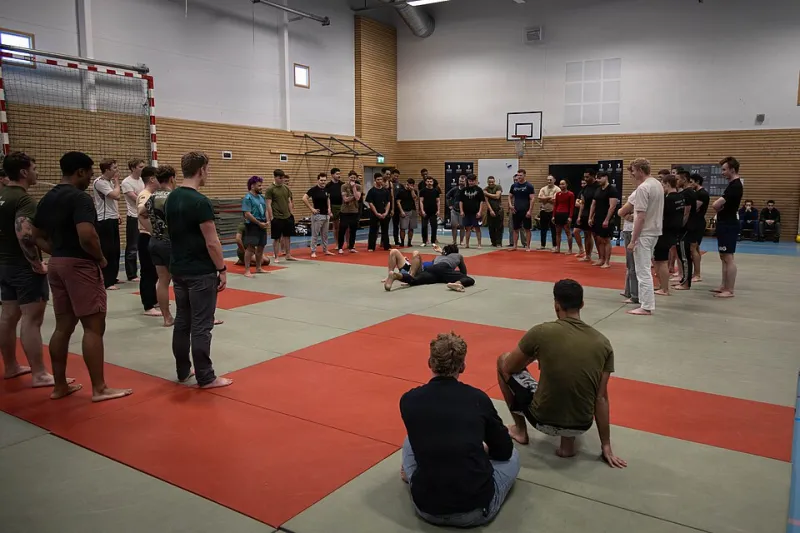
Photo by Photo by yousef samuil on Unsplash on Unsplash
There are finishes, and then there are statements. Some submissions end a fight. Others end an era of thinking. When Enson Inoue locked up a triangle choke against Kazushi Sakuraba, he did both — and the American MMA community, whether it knew it at the time or not, was never going to look at ground fighting the same way again.
This wasn't a lucky scramble or a desperate hail mary from the bottom. It was surgical. Deliberate. The kind of thing that makes you rewind the footage and ask, how did he even see that opening? Breaking it down frame by frame tells you everything you need to know about why Enson was years ahead of the curve.
Reading the Room Before the Room Existed
To understand what made this submission so significant, you have to understand the landscape of American MMA at the time. Ground work in the US was largely dominated by a wrestling-first mentality — control position, work for the stoppage, survive on the bottom. Brazilian Jiu-Jitsu was gaining traction, sure, but the nuanced, chain-reaction submission game that Enson had absorbed through Japan's Shooto circuit? That was practically a foreign language.
Sakuraba was no easy mark, either. He was already building a reputation as a nightmare matchup for Brazilian fighters, someone with sharp instincts on the ground and the wrestling base to make submissions complicated. Going after him with a triangle choke — a move that requires precise angle management, hip mobility, and elite timing — was the kind of call most fighters wouldn't even consider in that moment.
Enson considered it. And then he executed it.
The Mechanics Behind the Magic
Let's get into the actual technique, because this is where the lesson lives.
The triangle choke works by using your legs to create a figure-four around your opponent's neck and one arm, cutting off blood flow to the carotid arteries. Simple enough in theory. In practice, especially against a live, resisting opponent in a high-stakes fight, it demands a very specific set of conditions to come together almost simultaneously.
First, there's the angle. A flat triangle rarely finishes anyone at a high level. You need your hips to shift — typically at a 45-degree angle or more — to tighten the lock and eliminate the space that lets your opponent posture out or stack you. Enson's hip movement in this exchange was textbook, almost instructional in how cleanly he adjusted.
Second, there's the arm control. Trapping your opponent's arm across their own centerline is what transforms a loose leg wrap into an actual choke. Miss that detail and you're just holding on. Enson didn't miss it. The arm went across, the pressure built, and Sakuraba's options dried up fast.
Third — and this is the part that doesn't get enough credit — there's the entry. Nobody just wanders into a triangle. Enson created the opening through positional pressure and a reading of Sakuraba's weight distribution that spoke to a level of fight IQ most American grapplers at the time simply hadn't developed. He wasn't reacting. He was anticipating.
Why American Coaches Took Notice
Here's where the cultural impact really kicks in. When fight footage from Japan started circulating more widely in American gyms — through VHS tapes, early internet forums, and word of mouth among coaches — this performance became a reference point. Not just a reference point. The reference point for what a high-level submission game could look like against a quality opponent.
Coaches who had been drilling triangles as a secondary or even tertiary technique started reevaluating. The question shifted from can we finish with this? to why aren't we building entire game plans around this? That's a fundamental change in how you approach curriculum design for a training camp.
Gyms in California, New York, and across the Midwest started incorporating more hip-escape drills, more angle work, more emphasis on the entry sequences that make submissions available in the first place rather than waiting for them to fall into your lap. You can trace a straight line from Enson's performance to the evolution of American BJJ integration in MMA — it's not a stretch to say he helped accelerate a shift that might have taken years longer without visible proof that it worked at the highest level.
Fight IQ as a Force Multiplier
Technique alone doesn't explain everything here. What elevated this beyond a highlight was the decision-making layered on top of the physical execution.
Enson chose this submission in a moment when many fighters would have played it safe — worked for top position, looked for ground and pound, avoided the risk of getting stacked or reversed from the guard. The willingness to commit to a triangle against a dangerous, intelligent opponent reflects a kind of competitive confidence that can't be taught purely through drilling. It comes from understanding your own game so thoroughly that you trust it under pressure.
That trust — that knowing — is a huge part of what Enson's legacy represents. He wasn't gambling. He was playing a hand he'd built through years of serious technical work in Japan, and he played it at exactly the right moment.
The Blueprint That Still Echoes
Walk into almost any serious MMA gym in the US today and watch a ground game session. You'll see triangle entries being drilled from multiple positions. You'll hear coaches talking about hip angles, arm traps, and the importance of reading posture before committing to a lock. That vocabulary, that curriculum emphasis, owes a real debt to what fighters like Enson put on film when American MMA was still figuring out what elite ground work actually looked like.
The submission that finished Sakuraba wasn't just a finish. It was a demonstration — proof of concept that a thinking fighter with a refined, technically deep ground game could impose his will on some of the best competition in the world. That proof changed how a generation of coaches thought about what their fighters needed to know.
One triangle. One moment. A whole lot of gym sessions that got a little smarter because of it.