Ground Zero: Why Modern MMA's Strike-Heavy Culture Is Leaving a Dangerous Gap on the Mat
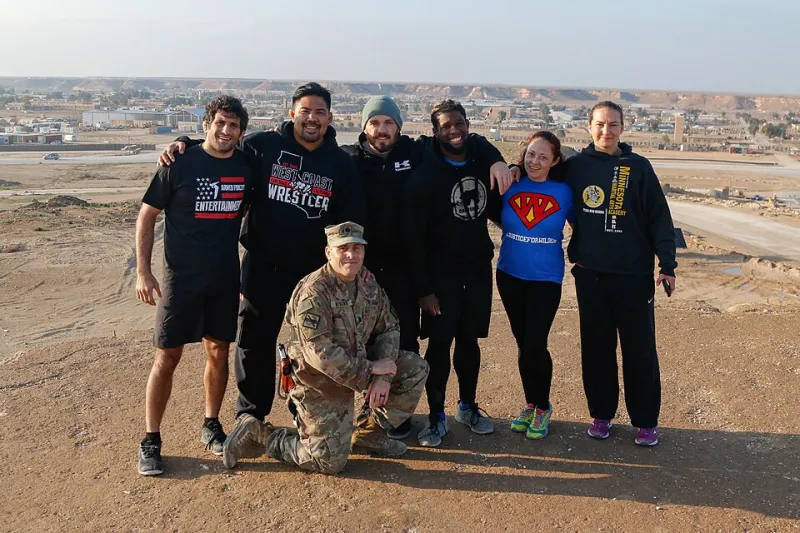
Photo: AL ASAD AIR BASE, IRAQ 12.18.2018 Photo by 1st Lt. Leland White 201st Regional Support Group, Public domain, via Wikimedia Commons
There's no question that MMA striking has never looked better. Turn on a UFC card right now and you'll see head kick knockouts, spinning elbows, and counter-punching combinations that would've felt right at home in a Muay Thai stadium. Israel Adesanya makes the octagon look like his personal canvas. Alex Pereira hits like a freight train wearing gloves. Alexander Volkanovski has built a masterclass in pressure-based boxing that's helped him dominate a loaded featherweight division.
But here's the thing — every so often, the floor opens up.
A takedown lands. A scramble turns ugly. And suddenly some of the most technically gifted strikers in the world are staring at the ceiling, defending submissions they clearly haven't drilled enough. It's become a pattern that's hard to ignore, and it points to a structural problem in how modern camps are building fighters.
Enson Inoue saw this coming. He just saw it about 25 years too early.
The Striking Boom and Its Hidden Cost
The sport's evolution toward striking isn't random — it follows the money, the highlights, and the casual fan. A brutal knockout clip goes viral. A slick submission doesn't always carry the same immediate pop on social media. So gyms respond. Coaches prioritize stand-up. Prospects spend more hours on the pads than on the mats.
Adesanya's rise accelerated this. So did the Pereira era. Watching those guys work is genuinely impressive, and their success has influenced how an entire generation of fighters trains. The problem is that elite grapplers haven't disappeared — they've just gotten more patient.
Look at what happened when Adesanya faced Jared Cannonier or how Pereira's ground game remains a legitimate question mark heading into any fight against a quality wrestler. Volkanovski, for all his brilliance, has faced pressure from Islam Makhachev that exposed what happens when an elite striker runs into a complete fighter who can shift the terrain of the fight at will.
This isn't a knock on those guys. It's a structural observation about where the sport's collective development has drifted.
What Enson Actually Built — and Why It Mattered
Enson Inoue didn't just happen to be good at submissions. He built an entire fighting philosophy around the idea that controlling where and how a fight takes place was the foundation of everything else. His grappling wasn't reactive — it was proactive. He wasn't waiting to get taken down and survive. He was hunting.
Watch his fights from his Shooto and Pride days and you'll notice something that gets lost in the "he was tough" narrative: Enson had a sophisticated understanding of position. His guard work wasn't just defensive — he used it as a launching pad. His transitions between positions showed a chain-wrestling intelligence that most American fighters at the time simply hadn't developed.
Specifically, his ability to transition from half guard to back control was ahead of its era. He wasn't just holding on — he was always working toward the dominant position that would let him finish. That's a detail that matters enormously when you apply it to the modern game.
The Technical Gaps Modern Camps Should Fill
Here's where it gets practical. If you're a coach or a fighter reading this, the Inoue blueprint offers some specific correctives worth studying.
Guard retention as offense, not just survival. Too many fighters today treat the guard as a place to stall and wait for a stand-up restart. Enson used guard actively — looking for sweeps, submissions, and positional improvements from the bottom. The rubber guard and modern guard systems owe a philosophical debt to this approach, but it's still underutilized at the elite level.
Submission setups from dominant positions. Enson wasn't just hunting armbars — he was creating them through positional pressure that forced his opponents to make mistakes. Modern fighters often go for the quick finish without the setup work, which is why submission attempts get defended more easily today.
The clinch-to-floor transition. His ability to convert clinch work into takedowns and then immediately into submission attempts was seamless in a way that most modern fighters' games aren't. There's a gap between the clinch and the ground game that coaches often treat as two separate departments. Enson treated them as one continuous system.
The Corrective Blueprint
None of this means strikers should stop striking. That would be ridiculous. But the sport's current moment is asking a specific question: what happens when the striking gap between fighters narrows and the fight goes to the floor?
The answer, historically, has always been the same — the fighter with the deeper grappling foundation wins. Not always in the highlight-reel way, but consistently, over the course of a career and a legacy.
Enson Inoue built his entire identity around that foundation. He wasn't the most explosive athlete in the room. He wasn't the biggest guy in any weight class he competed in. What he had was a submission-first philosophy that forced every opponent to fight on terms that favored him — and that's a competitive advantage that doesn't expire.
Modern camps talk a lot about being "complete fighters." But completeness means something specific: it means being dangerous everywhere, including on the mat, including from the bottom, including in the scrambles that happen between the stand-up and the ground.
Until more camps take that seriously — until the grappling foundation gets the same investment as the striking clinic — we're going to keep watching elite strikers get exposed by fighters who simply refused to let the fight stay standing.
Enson figured that out before most coaches in this country were even watching MMA. That's not a footnote. That's a lesson.